-
🏘️ Seoul vs Busan: Real Monthly Budget Comparison 2026 (City-by-City Cost Analysis for Foreigners)Global Career & Travel 2026. 4. 4. 22:18반응형SMALL
🏘️ Seoul vs Busan: Real Monthly Budget Comparison 2026
City-by-City Cost Analysis for Foreigners: Save ₩400K–₩800K by Choosing the Right City
Seoul costs 40% more than Busan. One city choice could save you ₩400K–₩800K monthly!
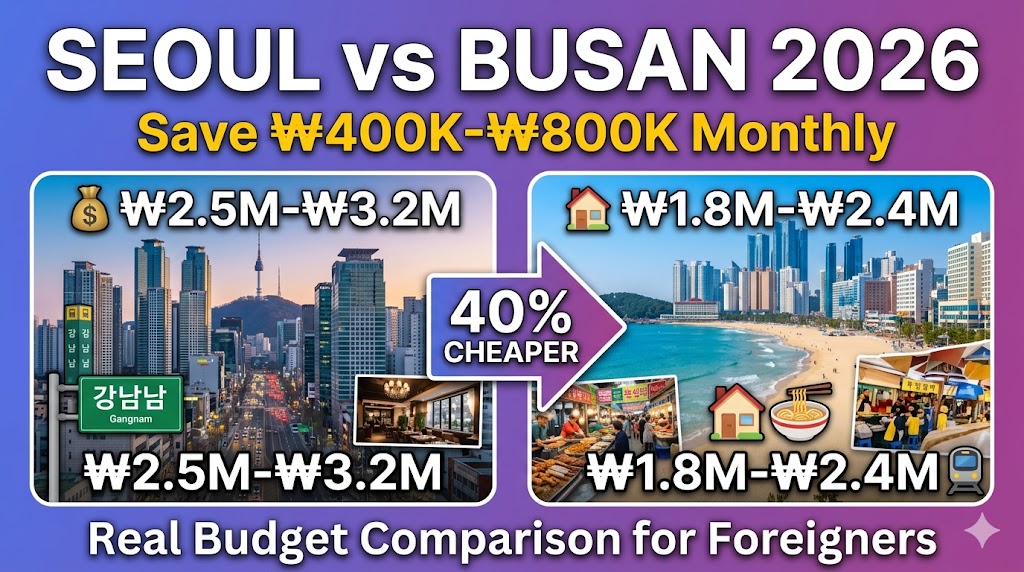
Which Korean city offers the best value for foreigners? Compare actual living costs between Seoul, Busan, Daegu, Incheon, and Jeju Island. Real breakdown of rent, food, transportation, and total monthly budget. Which Korean city offers the best value for foreigners? Compare actual living costs between Seoul, Busan, Daegu, Incheon, and Jeju Island. Real breakdown of rent, food, transportation, and total monthly budget.
🏙️ Quick City Comparison: Monthly Budget at a Glance
Here's a quick comparison of total monthly expenses for a single foreigner in Korea's major cities. These figures include accommodation, food, transportation, utilities, and entertainment.
🌃 Seoul (Central)
Most Expensive
₩2.5M–₩3.2M🏠 Rent: ₩1M–₩1.5M
⭐ Nightlife, jobs, culture
💡 Best for: High earners, career-focused
🌉 Busan
40% Cheaper than Seoul
₩1.8M–₩2.4M🏠 Rent: ₩600K–₩900K
⭐ Beach, expat community
💡 Best for: Budget-conscious, quality of life
🏞️ Daegu
Most Affordable
₩1.5M–₩2M🏠 Rent: ₩450K–₩700K
⭐ Student-friendly, quiet
💡 Best for: Students, minimum budget
📊 Detailed Expense Breakdown by City
Let's break down each major expense category by city to see where you can save the most.
🏠 Accommodation Costs (The Biggest Difference)
City Monthly Rent Jeonse Deposit Studio vs 1BR 🌃 Seoul Central ₩1M–₩1.5M ₩200M–₩400M Studio higher 🌃 Seoul Suburbs (Gangnam) ₩700K–₩1.2M ₩150M–₩300M Commute +30min 🌉 Busan ₩600K–₩900K ₩100M–₩200M Similar pricing 🏞️ Daegu ₩450K–₩700K ₩80M–₩150M Most affordable 🏘️ Incheon ₩700K–₩1.1M ₩120M–₩220M Airport access 🌾 Jeju Island ₩800K–₩1.2M ₩150M–₩280M Tourist premium 🍜 Food & Dining Costs
City Monthly Budget Cheap Meal Restaurant Meal 🌃 Seoul ₩500K–₩700K ₩4K–₩6K ₩12K–₩20K 🌉 Busan ₩400K–₩550K ₩3.5K–₩5K ₩10K–₩15K 🏞️ Daegu ₩350K–₩500K ₩3K–₩4.5K ₩9K–₩13K 🏘️ Incheon ₩450K–₩600K ₩3.5K–₩5.5K ₩11K–₩17K 🌾 Jeju Island ₩500K–₩700K ₩4K–₩6.5K ₩15K–₩25K 🚇 Transportation & Utilities
City Monthly Transport Utilities (Elec/Water/Gas) Total 🌃 Seoul ₩80K–₩150K ₩120K–₩180K ₩200K–₩330K 🌉 Busan ₩60K–₩100K ₩100K–₩150K ₩160K–₩250K 🏞️ Daegu ₩50K–₩80K ₩80K–₩120K ₩130K–₩200K 🏘️ Incheon ₩70K–₩120K ₩110K–₩160K ₩180K–₩280K 🌾 Jeju Island ₩80K–₩150K ₩130K–₩200K ₩210K–₩350K 🎯 Which City Should You Choose? A Complete Guide
✅ Best for Maximum Savings: Daegu
Monthly Budget: ₩1.5M–₩2M | Yearly Savings vs Seoul: ₩12M–₩18M
Daegu offers the cheapest accommodation and food costs. Perfect for students or those on tight budgets. Growing expat community, but fewer job opportunities than Seoul/Busan.
- ✓ Lowest rent: ₩450K–₩700K
- ✓ Cheapest food: ₩350K–₩500K
- ✓ Student-friendly atmosphere
- ✗ Fewer English-teaching jobs
- ✗ Less nightlife & entertainment
✅ Best for Value & Quality: Busan
Monthly Budget: ₩1.8M–₩2.4M | Yearly Savings vs Seoul: ₩8.4M–₩13M
Busan strikes the perfect balance—40% cheaper than Seoul but with excellent job opportunities, beach access, and a thriving expat community. Increasingly popular with remote workers.
- ✓ 40% cheaper than Seoul
- ✓ Strong job market (English teaching, IT)
- ✓ Beach, entertainment, expat community
- ✓ Growing tech industry
- ✓ 2-hour train to Seoul
✅ Best for Career Growth: Seoul
Monthly Budget: ₩2.5M–₩3.2M | Best for: High earners, ambitious careers
Seoul is expensive but offers unmatched job opportunities, higher salaries, and extensive expat networks. Worth it if your salary can cover the costs.
- ✓ Most job opportunities
- ✓ Highest salaries (+30–50%)
- ✓ Extensive expat community
- ✓ World-class nightlife & culture
- ✗ Most expensive city in Korea
✅ Best for Convenience: Incheon
Monthly Budget: ₩1.9M–₩2.5M | Best for: Frequent travelers, airport workers
Close to Incheon Airport (20 min). Moderate costs, good job market, and growing international community. Check travel guide for flight booking tips.
- ✓ Direct airport access
- ✓ Moderate costs (20% cheaper than Seoul)
- ✓ Good job opportunities
- ✗ Less established expat scene than Seoul/Busan
⚠️ Special Case: Jeju Island
Monthly Budget: ₩2M–₩2.8M | Best for: Remote workers, visa flexibility
Tourist destination with higher food/entertainment costs. Growing expat community but limited job opportunities. Good for digital nomads on D-10 visa.
- ✓ Unique lifestyle, beach living
- ✓ D-10 (Digital Nomad) visa available
- ✓ International community
- ✗ Food costs 20% higher than mainland
- ✗ Fewer employment opportunities
💡 Pro Tips: How to Save More in Any City
🏠 Accommodation Strategy
- ✓ Move to suburbs: Save ₩200K–₩400K monthly (but add commute time)
- ✓ Share apartment: Split rent with roommate (save 40%)
- ✓ Goshiwon: Ultra-cheap (₩300K–₩500K) but tiny rooms
- ✓ Negotiate Jeonse: Lower deposit = lower monthly costs
🍜 Food Strategy
- ✓ Eat at university cafeterias: ₩3K–₩5K meals
- ✓ Shop at traditional markets: 30% cheaper than regular stores
- ✓ Buy in bulk from Costco: Membership pays for itself in 1 month
🚇 Transportation Strategy
- ✓ Get Cashbee card: Extra ₩2,500 credit per ₩50K loaded
- ✓ Monthly pass: Unlimited subway for ₩65K (vs ₩2,500/ride)
- ✓ Bike sharing: ₩10,900/month for unlimited rides
Choose Your Perfect City in Korea
Your city choice is one of the most important financial decisions. The difference between cities can be ₩400K–₩800K monthly (₩4.8M–₩9.6M annually!).
💰 Compare Salary vs Cost of Living❓ Frequently Asked Questions
Q: Can I actually save ₩400K–₩800K by moving to Busan from Seoul?A: Yes. Rent alone is 30–40% cheaper. With lower food and entertainment costs, total savings range from ₩400K–₩800K monthly depending on your lifestyle.
Q: Is Busan a good choice for job seekers?A: Absolutely. Busan has a strong job market for English teachers, IT professionals, and customer service roles. See best jobs by city for details. Salaries are 10–15% lower than Seoul but cost of living is 40% lower—net positive.
Q: What's the trade-off between saving money and job opportunities?A: Daegu offers lowest costs but fewest jobs. Busan balances both. Seoul has most jobs but highest costs. Choose based on your priority: savings vs career growth.
Q: Is Seoul worth the extra cost?A: Only if your salary is at least 30–50% higher. Entry-level teachers may struggle in Seoul but thrive in Busan on the same salary.
Q: Can I live on ₩1.5M in any Korean city?A: Comfortably in Daegu only. In Busan it's tight. In Seoul, virtually impossible unless you share housing and eat very cheaply. Check salary vs cost of living for realistic budgets.
📚 Complete Foreigner's Guide to Korea
This article is part of our comprehensive guide for foreigners in Korea. Explore related topics to make the best decision.
💰 Salary vs Cost of Living
Compare your expected salary against real living expenses in Korea.
💼 Best Jobs by City
Top 10 highest-paying jobs and where to find them in Korea.
📊 Visa Benefits Comparison
E-1, E-2, E-7, D-10 visa requirements by city.
🇰🇷 How to Get a Job
Ultimate guide for finding and securing employment in Korea 2026.
📋 New Visa Rules 2026
Immigration guide and new visa regulations for moving to South Korea.
✈️ Travel Guide 2026
South Korea travel tips, discounts, and K-ETA information.
⚠️ Disclaimer
Data Accuracy: These figures are based on 2026 market data and typical expat spending patterns. Actual costs vary by district, neighborhood, and personal lifestyle.
Regional Variations: Prices within each city vary. Seoul suburbs cost 30% less than Gangnam. Rural areas near cities cost even less.
Seasonal Changes: Rent prices fluctuate seasonally. Summer (June–August) is peak season with higher prices.
Exchange Rates: All prices in Korean Won (KRW). Convert using current rates.
📌 Official Sources: Korea Immigration Service · Seoul Metropolitan Government · Busan Metropolitan Government · Statistics Korea
반응형LIST'Global Career & Travel' 카테고리의 다른 글