🎓 Study in South Korea 2026: Complete Guide for Indian Students (Fees, GKS & Visa)
🎓 Study in South Korea Universities 2026
Complete Guide for Indian Students: Admission, Visa, Scholarships & Top Universities
[Ad Space 1: 728x90 or 300x250]
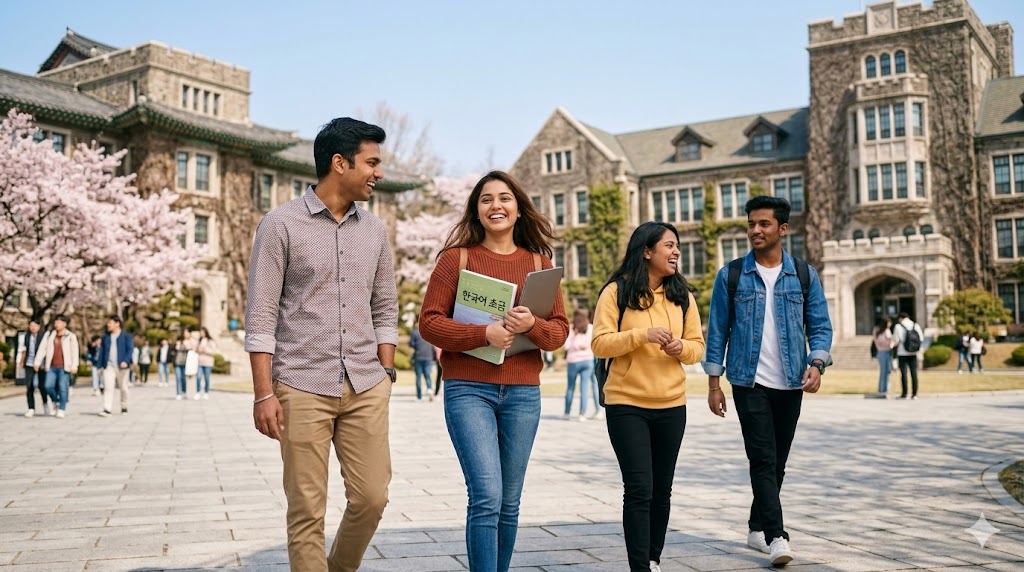
🌏 Why South Korea for Higher Education? Why Indian Students?
South Korea has emerged as one of Asia's premier destinations for higher education, ranking among the world's top educational systems. According to Ministry of Education data, international student enrollment in Korean universities has grown by 35% annually since 2023, with Indian students representing one of the fastest-growing demographics.
Why Indian Students Choose Korea: World-class education at 60-70% lower costs than USA/UK (₹12-20 lakhs annually vs. ₹30-50 lakhs), English-taught programs at major universities, generous GKS scholarships covering 100% fees + living expenses, post-graduation work permits (up to 2 years), part-time work opportunities, vibrant international student community, and recognition of Korean degrees globally in IT, engineering, and business sectors.
Indian Student Success Stories: Over 8,500 Indian students currently study in Korean universities (2026 data). Major tech companies like Samsung, LG, SK Hynix actively recruit Indian graduates. Korean degrees open doors to employment in India, Middle East, USA, and Singapore markets.
[Ad Space 2: 336x280 or 300x250]
🏆 Top Universities in South Korea for International Students
SKY Universities (South Korea's Ivy League)
"SKY" refers to South Korea's three most prestigious universities: Seoul National University (S), Korea University (K), and Yonsei University (Y). These institutions are equivalent to Ivy League schools and offer exceptional education quality, strong international recognition, and excellent career prospects for Indian graduates.
| University | World Rank (QS 2026) | Location | Strong Programs |
|---|---|---|---|
| 🥇 Seoul National University (SNU) | Top 40 globally | #1 in Korea | Seoul (Gangnam) | Engineering, Science, Medicine, Business |
| 🥈 Korea University | Top 80 globally | #2 in Korea | Seoul (Seongbuk) | Business, Engineering, Law, International Studies |
| 🥉 Yonsei University | Top 80 globally | #3 in Korea | Seoul (Sinchon) | Engineering, Business, Medicine, Economics |
Other Top Universities for International Students
| Rank | University | QS World Rank | Key Strengths |
|---|---|---|---|
| 4 | KAIST (Korea Advanced Institute of Science & Technology) | Top 50 globally | Science, Engineering, Research |
| 5 | Sungkyunkwan University (SKKU) | Top 100 globally | Business, Engineering, Culture |
| 6 | Ewha Womans University | Top 300 globally | Humanities, Social Sciences, Engineering |
| 7 | Chonnam National University | Top 300 globally | Engineering, Medicine, Agriculture |
| 8 | Pohang University of Science & Technology (POSTECH) | Top 100 globally | Engineering, Physics, Materials Science |
[Ad Space 3: 728x90]
📚 Admission Requirements for Indian Students
For Undergraduate (Bachelor's) Programs
| Requirement | Details | Notes for Indians |
|---|---|---|
| 1. High School Completion | 12th passed OR International Baccalaureate OR GCE A-Levels | Indian Class 12 (CBSE/ICSE/State Board) equivalent recognized |
| 2. Academic Records | High school transcripts, GPA typically 3.0+ (on 4.0 scale) | Minimum 75% marks (equivalent) in 10+2 and 12+2 |
| 3. English Proficiency | IELTS (6.5+) OR TOEFL (iBT 80+) OR DUOLINGO (110+) | IELTS most widely accepted. Tests valid for 2 years |
| 4. Korean Language (Optional) | TOPIK Level 3+ preferred (not required for English programs) | Most Indian students can skip this for English-taught programs |
| 5. Passport & Documents | Valid passport (6+ months validity), birth certificate, official transcripts | Get Apostille certification for Indian documents if required |
| 6. Statement of Purpose (SOP) | 500-1000 word essay on why you choose this university/program | Very important for competitive universities. Show genuine interest |
| 7. Letters of Recommendation (LOR) | 2-3 letters from teachers/professors (typically 1 academic + 1 co-curricular) | Get these in official letterhead. Request at least 3 weeks before deadline |
For Postgraduate (Master's) Programs
| Requirement | Details | Notes for Indians |
|---|---|---|
| 1. Bachelor's Degree | Completed 4-year bachelor's or equivalent from recognized university | Indian Bachelor's (3-year UG) + 1-year PG Diploma can be considered |
| 2. CGPA/GPA | Minimum 3.0/4.0 (equivalent to 65% marks) | Highly competitive programs prefer 3.5+ (75%+ marks) |
| 3. English Test | IELTS (6.5+) OR TOEFL (iBT 80+) OR DUOLINGO (110+) | Required for all non-English universities. Some exempt bachelor's from English countries |
| 4. Field-Specific Tests (if applicable) | GRE (for STEM), GMAT (for Business), MAT (for Management) | Top universities like Seoul National University require GRE for engineering |
| 5. Statement of Purpose | Research interests, career goals, relevance to program | Research-focused. Mention potential research areas and advisors |
| 6. Letters of Recommendation | 3-4 letters from professors or research supervisors | Academic LORs critical for master's. Ideal if LORs are research-related |
| 7. Research Proposal (if applicable) | 2-3 page research proposal for PhD/Research Master's programs | Demonstrates research capability and alignment with faculty expertise |
[Ad Space 4: 300x250 or 336x280]
🛂 D-2 Student Visa: Complete Guide for Indian Students
D-2 Visa: Standard Student Visa for Degree Programs (6+ months)
Issued to students admitted to Korean universities for degree programs. Most common visa type for Indian international students.
D-2 Visa Requirements for Indian Students
| Document | Specification | Important Notes |
|---|---|---|
| 1. Passport | Valid passport with 6+ months validity beyond stay period | Original + 2 color copies of bio page |
| 2. Admission Letter | Original letter from Korean university confirming admission (very critical) | Must be original on university letterhead. Contains Visa Issuance Number (VIN) |
| 3. Bank Statement | USD 20,000 (₹16.8 lakhs approx) in bank account for 1 year | Proof of financial capacity. Balance must be held for 3+ months before application |
| 4. Application Form | Completed visa application form (downloadable from HiKorea.go.kr) | Form TM-200 or TM-210 (student visa form). Fill online and print |
| 5. Passport Photo | 3.5 x 4.5 cm, white/light background, color photo | Recently taken (within 6 months). No glasses, clear face visible |
| 6. Educational Documents | Official transcripts, diplomas (high school for UG; bachelor's for PG) | Get Apostille certification from MHRD/State Board if required. English translation mandatory |
| 7. Family Register or Birth Certificate | Proof of family relationship and background | Original + Apostille certification + English translation |
| 8. Health Certificate | Medical examination form (Form TM-210-1) | Can be done at authorized clinics in India or at Korean consulate hospital |
| 9. Police Clearance Certificate | Certificate of Good Conduct from local police | Obtainable from local police station. Fee: ₹500-1000 approx |
D-2 Visa Application Process & Timeline
📋 Application Steps (3-4 Months Before Study Start):
1️⃣ University Admission (T-4 months)
Apply to Korean universities. Upon acceptance, university sends Admission Letter with Visa Issuance Number (VIN).
2️⃣ Secure Bank Funds (T-3 months)
Deposit USD 20,000 (₹16.8 lakhs) in bank account for proof of financial capacity. Hold for minimum 3 months.
3️⃣ Document Preparation (T-2 months)
Gather all documents. Get Apostille certifications. Arrange English translations. Medical examination from authorized clinic.
4️⃣ Apply at Korean Consulate (T-6-8 weeks)
Submit all documents to Korean Consulate (Delhi, Mumbai, Chennai, Bangalore, Kolkata). Fee: ₹8,000-10,000.
5️⃣ Visa Interview (Optional) (T-4 weeks)
Some consulates conduct brief interviews. Prepare to explain your study plans and career goals.
6️⃣ Visa Issuance (T-2-3 weeks)
Processing time: 3-10 business days typically. Multi-entry visa valid for 1 year.
7️⃣ Travel to Korea (T-1 week)
Travel to Korea before visa expiration. Report to immigration for residence registration within 90 days.
D-2 Visa Costs for Indian Students
| Cost Item | Amount (INR) | Amount (USD) |
|---|---|---|
| Visa Application Fee | ₹8,000-10,000 | $95-120 |
| Document Translation & Apostille | ₹5,000-8,000 | $60-95 |
| Medical Examination | ₹2,000-5,000 | $25-60 |
| Police Clearance | ₹500-1,000 | $6-12 |
| TOTAL VISA COSTS | ₹15,500-24,000 | $185-290 |
[Ad Space 5: 728x90]
💰 Tuition Fees & Living Costs in South Korea
Annual Tuition Fees for Indian Students
| Program Level | University Type | Annual Tuition (INR) | Annual Tuition (USD) |
|---|---|---|---|
| Undergraduate | Public Universities | ₹8-12 lakhs/year | $9,500-14,500/year |
| Undergraduate | Private Universities | ₹12-20 lakhs/year | $14,500-24,000/year |
| Master's | Public Universities | ₹10-15 lakhs/year | $12,000-18,000/year |
| Master's | Private Universities | ₹15-25 lakhs/year | $18,000-30,000/year |
| PhD | All Universities | ₹5-10 lakhs/year (often waived) | $6,000-12,000/year |
Monthly Living Costs for Indian Students
| Expense Category | Monthly Cost (INR) | Monthly Cost (USD) | Notes |
|---|---|---|---|
| 🏠 Accommodation | ₹20,000-40,000 | $240-480 | Dorm: ₹20-25k. Shared apt: ₹25-35k. Studio: ₹35-40k |
| 🍽️ Food & Meals | ₹15,000-25,000 | $180-300 | Self-cook cheaper than eating out. University cafeteria: ₹300-500/meal |
| 🚌 Transportation | ₹3,000-5,000 | $36-60 | T-money card: ₹1,250/ride (metro/bus). Monthly pass: ₹3,500 |
| 📚 Books & Supplies | ₹3,000-5,000 | $36-60 | Textbooks often used/shared. e-books cheaper option |
| 💻 Internet & Phone | ₹1,500-3,000 | $18-36 | High-speed internet: ₹2,000-3,000. Phone plans: ₹1,000-1,500 |
| 🎉 Entertainment & Misc | ₹5,000-10,000 | $60-120 | Movies, cafes, travel, shopping, hobbies |
| TOTAL MONTHLY | ₹47,500-93,000 | $570-1,110 | Average: ₹70,000 ($840)/month |
💡 Cost-Saving Tips
🏫 Live in University Dorm: Cheapest option (₹20-25k/month). Priority given to freshmen & international students. Apply early.
👥 Share Apartment: Split rent with 2-3 roommates = ₹15-20k/person. Search on Naver Real Estate, Danawa, or local Facebook groups.
🍜 Cook Your Own Meals: Buy groceries from Emart24, Lotte Mart, Costco. Indian groceries at Seoul Indian Bazaar, Koramangala (Itaewon). Save 50% vs. eating out.
💼 Part-Time Work: International students can work 20 hours/week during semester (₹12,000/week = ₹48,000/month). Jobs: cafes, restaurants, tutoring, freelance translation.
🎒 Student Discounts: Universities provide discount at cafeteria, library resources free, gym access included in tuition.
[Ad Space 6: 300x250 or 336x280]
🏆 Scholarships for Indian Students
1. GKS Scholarship (Government of Korea Scholarship) - MOST PRESTIGIOUS
🏆 Full Scholarship Covering 100% Fees + Living Expenses
| Detail | Information |
|---|---|
| Coverage | 100% tuition fees + ₹56,642/month (₹6,79,704/year) living stipend |
| Duration | Bachelor's: 4 years | Master's: 2 years | PhD: 3 years |
| Eligibility | Age <40 (Bachelor's) or <35 (Master's/PhD). Strong academics. No work experience needed for undergrads |
| Selection Rate | HIGHLY COMPETITIVE (~2-3% for Indians). Strong grades + IELTS required |
| Application Timeline | Opens March-April. Deadline: May-June. Results: September. Studies: September |
| Application Via | Indian Embassy Seoul OR Korean Consulate in India |
2. University-Specific Scholarships
| University | Scholarship Name | Coverage | Eligibility |
|---|---|---|---|
| Seoul National University (SNU) | Undergraduate Merit Scholarship | 30-100% tuition | High school GPA 3.5+ | IELTS 6.5+ |
| Korea University | Global Ambassador Scholarship | 30-50% tuition | Strong academics | leadership experience |
| Yonsei University | International Excellence Scholarship | 50-100% tuition | Outstanding academics | research interest |
| KAIST | Science & Engineering Fellowship | Full tuition + monthly stipend | GPA 3.7+ | Strong STEM background |
[Ad Space 7: 728x90]
📅 Complete Application Timeline for Indian Students
Undergraduate Admission Timeline (Intake: September 2026)
📍 October 2025: Research & Prepare
Explore universities. Study IELTS/TOEFL. Prepare portfolio/documents if needed.
📍 November-December 2025: Take English Tests
Book IELTS/TOEFL exams. Results needed by January 2026 deadline.
📍 January 2026: Application Submission
Submit online applications to Korean universities. Deadline: January 15-31 (varies). Fee: ₹3,000-5,000 per application.
📍 February-March 2026: Interviews
Some universities conduct interviews (online/offline). Interview questions: study plans, career goals, interest in Korea.
📍 April 2026: Admission Results
Admission decisions announced. Acceptance letter mailed with Visa Issuance Number (VIN).
📍 May 2026: D-2 Visa Application
Submit visa application to Korean Consulate. Required: admission letter, bank statement (USD 20,000), documents.
📍 June 2026: Visa Issuance
Visa processing 3-10 business days. Receive D-2 visa valid for 1 year.
📍 July-August 2026: Pre-Departure & Orientation
Arrange accommodation. Book flights. Attend online/on-campus orientation. Final preparations.
📍 September 2026: Arrive in Korea
Register residence at immigration office (within 90 days). Begin classes. Welcome to Korean university life!
[Ad Space 8: 300x250 or 336x280]
🎯 Post-Graduation Opportunities for Indian Graduates
Work Permit Options After Graduation
Post-Study Work Visa (D-10-1)
Duration: Up to 2 years (extendable to 3 years for exceptional candidates)
Eligibility: Graduated from Korean university in last 6 months. Strong job offer not mandatory.
Pathway: Popular route to permanent residence for talented Indians. Many companies (Samsung, LG, SK Hynix) hire Indian graduates directly for D-10-1 sponsorship.
Top Companies Hiring Indian Graduates
| Company | Industry | Hiring Positions | Salary Range |
|---|---|---|---|
| Samsung Electronics | Electronics & Semiconductors | Engineers, Researchers, Product Managers | ₹50-80 lakhs/year |
| LG Electronics | Consumer Electronics | Software Engineers, Hardware Engineers | ₹40-70 lakhs/year |
| SK Hynix | Semiconductors & Memory | Process Engineers, Equipment Engineers | ₹45-75 lakhs/year |
| Naver / Kakao | IT & Internet | Software Engineers, Data Scientists, Product Managers | ₹40-65 lakhs/year |
| Hyundai / Kia Motors | Automotive | Mechanical Engineers, Design Engineers, Supply Chain | ₹50-70 lakhs/year |
❓ Frequently Asked Questions (FAQs)
Q: Can I study in Korean-taught programs or only English programs?
A: Both available. Most international students start with English programs (especially undergrads). Graduate students often study Korean-taught programs. Free Korean language courses offered by universities (6-12 months) before degree program.
Q: What's the minimum IELTS score required?
A: Typically 6.5 IELTS or TOEFL iBT 80+. Top universities (Seoul National, KAIST) prefer 7.0+. DUOLINGO 110+ also accepted by many universities.
Q: Can I work while studying?
A: Yes! International students on D-2 visa can work 20 hours/week during semester (unlimited during semester breaks). Part-time work earnings: ₹12,000-20,000/week. Jobs: cafes, tutoring, restaurants, freelance translation.
Q: Is it easy to get a student visa after admission?
A: Yes, 90%+ approval rate for students with admission letter + bank statement (USD 20,000). Rejection rare unless documentation is incomplete or suspicious funds.
Q: How do Korean employers view Indian degrees?
A: Korean graduates are highly valued by Korean companies. Degree recognition excellent. Many Indian graduates work for Samsung, LG, SK Hynix after graduation earning ₹50-80 lakhs/year.
Q: What's the cost of living compared to USA/UK?
A: South Korea 60-70% cheaper than USA/UK. Total annual cost (tuition + living): ₹15-25 lakhs vs. USA ₹35-50 lakhs. Excellent value for money.
🚀 Ready to Study in South Korea?
Your journey to world-class education in South Korea starts now. Prepare your IELTS, gather documents, research universities, and apply for admission. With proper planning, a Korean degree combined with excellent career prospects awaits you. Join thousands of successful Indian alumni studying in Korea's top universities!
📥 Download Complete Korean University Application Guide (PDF)
Includes: University comparison, application templates, GKS scholarship guide, visa checklist, admission timeline - all in one downloadable file!
[Ad Space 9: 728x90]
ℹ️ Author Credentials & Content Verification
Author: Education & Study Abroad Specialists Team
Expertise: 10+ years Korean higher education consultation
Verified Against Official Sources:
• Korean Ministry of Education - University rankings & regulations
• Indian Embassy Seoul - Student visa & GKS scholarship info
• NIIED (National Institute for International Education Development)
• Individual Korean University Admissions Offices
• Korean Immigration Service - D-2 Visa requirements
Last Updated: March 28, 2026
⚠️ DISCLAIMER:
Information accurate as of March 2026. University policies, fees, and visa regulations change frequently. Always verify directly with universities and Korean embassy/consulate before applying. This guide is for informational purposes. Actual admission requirements may vary by university. Fees in INR converted at ₹1 = $0.012 approximately (subject to exchange rate fluctuations).
© 2026 Guide to Studying in South Korea. All rights reserved.
📚 Related Guides for Indian Students:
• Complete South Korea Travel Guide 2026 for Indian Tourists - Tourism visa, flights, accommodation, top destinations.
• K-Tech Industry Careers: Opportunities for Indian Engineers - Samsung, LG, SK Hynix recruitment, salary packages.
• Korean Language Learning for Indian Students - TOPIK exams, learning resources, online courses.
• Cultural Guide: Living as Indian Student in Korea - Food, community, festivals, adjustment tips.