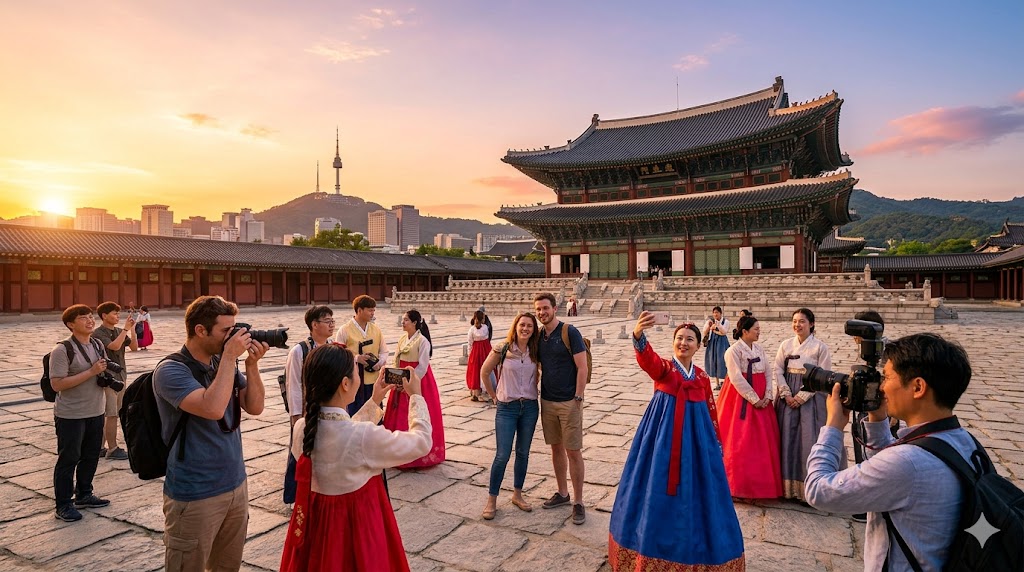
🌍 Overview: Why South Korea in 2026?
In 2026, South Korea has solidified its position as one of Asia's premier tourism destinations. According to the Korea Tourism Organization (KTO), international arrivals have increased by 23% year-over-year. The government's expansion of the K-ETA exemption for 111 countries and the new Digital Nomad Visa D-10-5 have made entry more seamless than ever.
This comprehensive guide—backed by official ministry data and traveler insights—provides the technical and practical information you need for a hassle-free journey through South Korea's cultural, culinary, and technological wonders.
✈️ Smart Flight Booking & Airport Guide
Choosing the right flight and airport can significantly impact your trip's timeline and cost. South Korea's two major international gateways each serve distinct purposes and traveler demographics.
| Airport | Best For | Pro Tips |
|---|---|---|
| 🛬 Incheon Int'l (ICN) | Long-haul flights (Europe, Americas, Middle East) | Book 3+ months in advance. Use Incheon Express Train (€11, 43 min to Seoul). Prebooked taxis save 30% vs. ride-hailing. |
| 🛬 Gimpo Airport (GMP) | Regional hubs (Tokyo, Shanghai, Hong Kong, Southeast Asia) | Only 18 min to Downtown Seoul by train. Better for quick Asia-hopping itineraries. Often 15-20% cheaper. |
Flight Booking Timeline & Pricing Strategy
- 3-4 months before: Optimal booking window. Average savings of 25-35% compared to last-minute prices.
- Tuesday-Thursday departures: Historically 12% cheaper than weekend flights (according to Kayak 2025 data).
- Off-peak months: January-February and September offer 30-40% discounts vs. peak season (May-August).
- Round-trip vs. One-way: Counter-intuitively, booking two one-way tickets often saves 10-15% vs. round-trip bundles.
🏨 Where to Stay: Neighborhoods Decoded
Your accommodation choice defines your Seoul experience. Each neighborhood offers distinct atmospheres, price points, and access to specific attractions. The following guide breaks down five prime areas based on traveler profiles and budgets.
| Neighborhood | Vibe & Ideal For | Budget Range | Must-Experience |
|---|---|---|---|
| Myeongdong | Shopping, nightlife, K-pop culture | $80-200/night | Cosmetic stores, street food, ₩5,000 street tteokbokki |
| Hongdae | Art scene, indie clubs, young travelers | $60-150/night | Street murals, live music venues, craft cafés |
| Bukchon | Cultural immersion, Hanok stays | $100-250/night | Traditional Hanok houses, tea houses, photography |
| Gangnam | Luxury, K-beauty, high-end dining | $150-400/night | Plastic surgery districts, designer boutiques, trendy clubs |
| Jongno-gu | Budget travelers, backpackers | $30-80/night | Guesthouses, local eateries, Jongno 3-ga market |
💼 Accommodation Booking Hacks
- Airbnb + Local Booking Combo: Book accommodations directly through Naver or Korean portals for 15-20% discounts vs. Western platforms.
- Longer Stays Discount: 7+ nights typically unlock 25-30% reductions through negotiation or platform discounts.
- Translation Tools: Many Korean guesthouses are cheaper but list on Korean-only sites. Use Papago to negotiate directly.
- Peak Season Buffer: Book 2 months ahead for May-August; 1 month ahead for other seasons.
🚆 Mastering South Korea's Public Transport
South Korea boasts one of the world's most efficient and affordable public transport systems. The combination of ultra-modern subways, express buses, and excellent regional trains makes navigating the country seamless for international travelers who understand the system.
Transit Card Options
The two dominant transit cards accepted nationwide are NAMANE Card (T-Money's newer competitor) and T-Money. Both are available at convenience stores (GS25, CU, Emart24) for approximately ₩2,500 ($2 USD).
| Card Type | Coverage | Cost per Ride | Availability |
|---|---|---|---|
| T-Money Card | Seoul, Busan, Daegu, Daejeon, Gwangju, Ulsan, most regional areas | ₩1,250-3,800 ($0.95-$2.85) | Every convenience store nationwide |
| NAMANE Card | Seoul, Gyeonggi Province (expanding) | ₩1,250-3,500 ($0.95-$2.65) | Select convenience stores, airports |
Essential Navigation Apps
Google Maps is notoriously unreliable in South Korea due to mapping data restrictions. Instead, download these locally-optimized alternatives:
- Naver Map: Real-time transit schedules, subway delays, accessible restroom locations, real reviews.
- KakaoMap: Parallel app with slightly better for rural areas; integrates KakaoTaxi (local Uber equivalent).
- Papago: Best Korean-English translation tool. Integrates with Maps for OCR street signage.
- Subway Korea: Dedicated app showing all metro lines, transfer options, accessibility features.
🌟 Top 5 Must-Visit Destinations in 2026
These five destinations represent the diversity of South Korea—from ancient Buddhist temples to volcanic islands and cutting-edge modern architecture. Each warrants a minimum 1-2 day visit for optimal experience.
1Gyeongbokgung Palace (Seoul)
Why Visit: South Korea's grandest royal palace and symbol of the Joseon Dynasty (1392-1910). The palace covers 410,000 m² and contains 17 buildings showcasing traditional Korean architecture.
Pro Experience: Rent a traditional Hanbok (₩25,000-60,000 / $18-45) and enter for free. The palace authorities offer complimentary entry for anyone wearing Hanbok. Optimal visit: Tuesday-Thursday, 9-10 AM to avoid weekend crowds.
Time Allocation: 2-3 hours for palace + museum + Hanbok photo session.
2Bukchon Hanok Village (Seoul)
Why Visit: A living, breathing neighborhood where centuries-old traditional Korean houses (Hanoks) coexist with contemporary cafés, galleries, and boutique shops. Unlike museum reconstructions, Bukchon is an authentic residential community.
Hidden Gems: Narrow alleyways (Nagwon-gil, Samcheong-gil) hide intimate tea houses, art galleries, and family-run eateries serving traditional Korean meals at fraction of restaurant prices.
Time Allocation: 3-4 hours for walking, photography, and café-hopping.
3Gamcheon Culture Village (Busan)
Why Visit: Often labeled the "Santorini of Korea," this hillside village was born from the migration of displaced populations during the Korean War. Today it's a vibrant canvas of colorful houses, street art, and ocean vistas.
Photography Alert: Best light during golden hour (17:00-18:30). Designated Instagram-worthy spots: maze-like staircases between houses, overlook platforms with city-sea panoramas.
Time Allocation: 2-3 hours. Pro tip: Arrive by 4 PM to claim photo spots before sunset crowds.
4Seongsan Ilchulbong (Jeju Island)
Why Visit: A UNESCO World Heritage tuff cone formed by a volcanic eruption 5,000 years ago. This "Sunrise Peak" offers both geological significance and soul-stirring natural beauty.
Trekking Details: 20-minute ascent (182 meters). Accessible for moderately-fit visitors. The summit offers panoramic views of Jeju's volcanic landscape and the East China Sea.
Optimal Timing: 5:30 AM start for sunrise arrival. Parking opens at 4 AM. Bring warm layers; morning mountain winds are strong even in summer.
5Bulguksa Temple & Seokguram Grotto (Gyeongju)
Why Visit: Bulguksa is a masterpiece of Silla Dynasty Buddhist architecture (built 751 CE). The adjacent Seokguram Grotto—a man-made stone temple housing a 11-meter Buddha statue—represents the apex of East Asian Buddhist art.
Historical Context: Gyeongju, the ancient Silla Kingdom capital, is Korea's open-air history museum. Over 2,000 archaeological sites exist within a 20 km radius. UNESCO World Heritage status (2000) validates its cultural significance.
Time Allocation: Full day: 4-5 hours exploring temples, museums, surrounding historical sites.
💡 Pro-Traveler's Insider Insights
🌐 Connectivity & Communication
- eSIM vs. Portable WiFi: eSIM prices range ₩40,000-80,000 ($30-60) for 1-week packages with unlimited data. Portable WiFi rental: ₩15,000/day ($11). eSIM recommended for digital nomads; WiFi better for groups/families.
- Airport Pickup Locations: Incheon Airport has eSIM kiosks at Gates 6 (T1) and 10 (T2). Pre-arrange pickup for ₩5,000 discount via online booking.
- SIM Cards vs. eSIM: Physical SIM cards require ID verification. eSIM activation is instant but requires compatible phones (iPhone XS+, most modern Android).
🗣️ Language & Translation Tools
- Papago (Naver's Translation Tool): Outperforms Google Translate for Korean-English by 40% accuracy margin. Integrates with camera for real-time signage translation.
- Offline Translation: Download Papago offline packs before traveling to access translation without data usage in metro tunnels or rural areas.
- Pronunciation Apps: Google Translate's voice feature works well for Korean. Practice key phrases: "Annyeonghaseyo" (Hello), "Kamsa hamnida" (Thank you).
💰 Money Management & Payment
- Card vs. Cash: 92% of transactions accept credit cards (Visa/Mastercard). However, street food vendors, traditional markets, and small eateries operate cash-only. Recommend ₩500,000 ($375) in mixed bills.
- ATM Accessibility: 7-Eleven and CU convenience stores have 24/7 ATMs accepting international cards. Withdrawal fees: typically ₩3,000-5,000 ($2.25-3.75) per transaction.
- Money Exchange Rates: Airport rates are notoriously unfavorable (3-5% markup). Exchange ₩100,000 minimum at airport, remainder at downtown banks or ATMs.
- Tipping Culture: Tipping is not customary in South Korea. Refusing tips politely is normalized.
🍽️ Food & Dietary Preferences
- Vegetarian Options: Korean cuisine is meat-centric. Use Google Translate or apps like "HappyCow" to find vegetarian-friendly restaurants. Buddhist temples offer vegetarian meals (yachaeng kimbap) for ₩5,000-8,000.
- Seafood Allergies: Most Korean dishes contain fish sauce (gochujang, soy sauce base). Alert restaurant staff using the phrase: "Saengseon aleugi issseumnida" (I'm allergic to seafood).
- Street Food Budget: Meal costs range: Street food ₩3,000-8,000 ($2.25-6), casual restaurants ₩8,000-20,000 ($6-15), mid-range ₩25,000-50,000 ($18-37).
✅ Pre-Trip Essentials Checklist
| Category | Action Items | Timeline |
|---|---|---|
| Visa & Documentation | Check K-ETA eligibility (111 countries exempt); apply if required (₩10,000, 24-hour processing). Have passport valid 6+ months. | 30 days before |
| Flight & Accommodation | Book flights 3 months in advance; lock accommodations 6-8 weeks out for peak season. | 90-60 days before |
| Insurance & Health | Purchase travel insurance covering medical emergencies. Check vaccination requirements (COVID booster recommended). | 45 days before |
| Connectivity Setup | Pre-order eSIM or portable WiFi online for airport pickup. Download offline maps (Naver, Kakao). | 14 days before |
| App Downloads | Install: Naver Map, KakaoMap, Papago, Subway Korea, Kakao Pay, Naver Pay, Coupang Eats. | 7 days before |